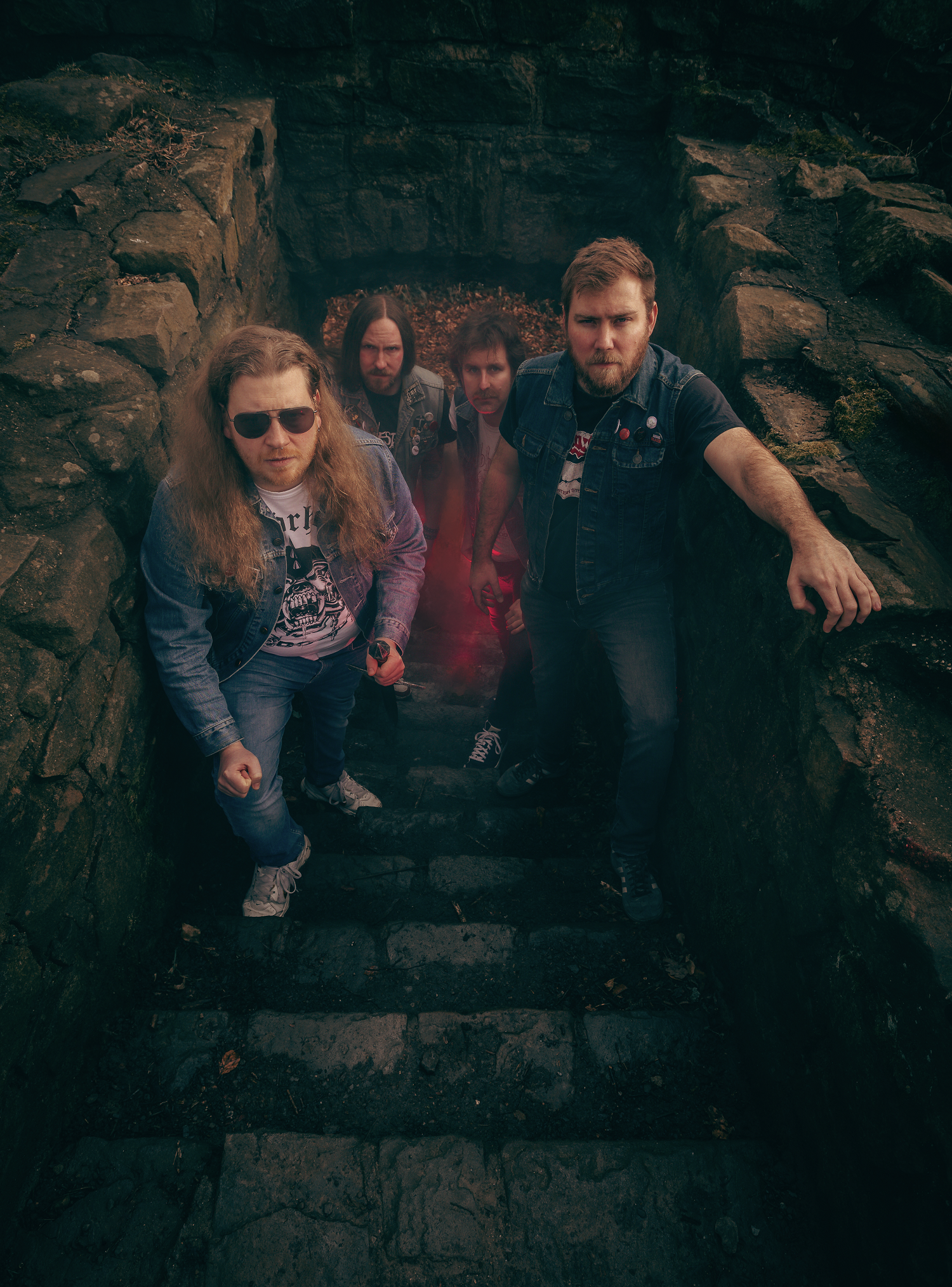

Iron Kobra have been part of the heavy metal underground since 2008, shaped by long friendships, shared influences and a clear sense of who they are. Their journey has taken them through changing line‑ups, new ideas and plenty of memorable moments, all while keeping their feet firmly planted in the world that first inspired them. In this interview, they look back at the early days, the experiences that shaped their path, and the interests that continue to colour their work today.
Interview
TheNwothm: You have been flying the heavy metal flag since 2008. For anyone meeting Iron Kobra for the first time, how would you introduce yourselves, your line-up and the place you call home?
I.K: WE ARE IRON KOBRA FROM GERMANY AND WE PLAY HEAVY METAL! We used to say that we’re Iron Kobra from Gelsenkirchen, but since most of the band doesn’t live in the city anymore, we just use the wider term of “Germany”. We’re an ‘old-school’ Heavy Metal band, that plays a weird mix of Heavy, Speed and Epic Metal with a sprinkle of Punkrock.
TheNwothm: Take us back to the early days. What brought the founding members together, and what convinced you that this was the right moment to start a band?
I.K: Two members of the first line-up of Iron Kobra , Ela and Kivi, used to play in another band together. While loading equipment for a gig into a van they were joking about the name of the drummer’s footpedal “Iron Cobra”, noting that it sounds like a classic Heavy Metal band. Being bored of the music both members played in the other band before and having a soft-spot for classic Heavy Metal at one point they just chose to found a new band referring to the aforementioned footpedal, but changing the “C” to a “K” in cobra, to make it look more crude and “German”. The exact moment was kind of iconic and fit the band’s imagery: we were riding to a nerdy board game convention, talking about the idea of “Iron Kobra” and by pure chance the other people in the car were instrumentalists as well, so we chose this constellation to be the band.
The first few songs have been massively influenced by the stuff we used to blast at parties back then: Living Death, Manowar, Iron Maiden, Thor. We wanted to play similar music and just go with it and see where it takes us, as the new wave of Thrash and Black/Thrash Metal has been on the rise in Germany and we wanted to play a style that was distinctly more on the “Heavy/Speed” Metal spectrum.
TheNwothm: Germany has a long and varied metal history, from raw speed metal to more melodic traditions. Growing up in that environment, what aspects of German metal culture shaped your approach, whether in sound, attitude or the way you present yourselves?
I.K: I think this had a huge influence on us as well our music. One key-moment would have been our discovery of Heavy Metal bands from the GDR like Formel 1, Biest, Merlin, Dr. Rock and all the other fantastic bands that were founded during a time of massive control and restrictions of media via the state. It was a huge inspiration to hear classic Heavy Metal bands singing in German that also sparked our ideas to write songs in our native language, although not exclusively. Also, growing up in the Ruhrpott-area, a melting pot of cultures and the birthplace of bands like Kreator, Sodom, Darkness, Violent Force and so on, has influenced us a lot. The Heavy Metal heritage that is laid upon this region is felt in the local scene and many of the places the bands back then used to visit, party at and play gigs in are still present today, even though those places have undergone changes throughout the years.
An anecdotal story for example: our singer/guitarist Ela got married right next to the location that used to be the Metal bar “Mephisto” a notorious place that’s depicted in many documentaries and movies about the German Heavy Metal scene of the 80’s, hosting people like the aforementioned bands as well as international guests like Mayhem in their demo-phase. Nowadays Germany still has a very strong, young Heavy Metal scene, especially the Ruhrpott-area, where we are from. New bands forming here and there, festivals and concerts specifically focused on underground “classic” Metal styles take place on a nearly weekly basis and venues and bars that play Heavy music all week long.
TheNwothm: Your music often taps into fantasy, adventure and larger-than-life imagery. What draws you to those worlds, and how do they connect to your own experiences?
I.K: Well, we’re all just fantasy and sci-fi buffs. Growing up playing fantasy board games like “Hero Quest”, reading Sword & Sorcery novels about “Elric of Melniboné”, playing dungeoncrawlers on Windows95 and watching Conan Rip-Offs on VHS. The world of fantasy offers a gateway into a world detached from your day to day life, where no schedules matter, no states of the world have any influence on you and where there is a mostly clear distinction between good and evil that the real very complicated world we live in right now doesn’t offer. It offers escapism and that weird and cosy feeling of nostalgia that many people relate to, especially in the underground Metal scene.
There is an abundance of great topics, lore and world building that offers a wide variety and base for lyrical themes to back up heavy riffs with. On the other hand, even though fantasy or sci-fi might give you that escapism you sometimes crave, those stories also work as metaphors for current events as well as conflicts happening in this world. Picture an ‘evil king’ for example, working as an illustration of a super-capitalist oligarch that we nowadays see way too many of on our current earth.
TheNwothm: Each member brings something distinct to the band. What personal interests or quirks outside of music quietly influence Iron Kobra’s sound or stage presence?
I.K: I guess the answers I gave above might give a little hint, haha. We’re all fantasy and sci-fi fans without obsessing about a certain franchise. But besides that, we have members that are drawn to hiking and exploring nature, especially Scandinavia, while other members have a soft-spot for Japanese (pop)culture and video games, especially of the retro kind (SNES, PcEngine, NeoGeo…) and cheesy Italian giallo movies to members that follow current political world events closely and motorcycling. But in the end we’re really homogenous when it comes to interests and hobbies, even though we come from very different backgrounds in terms of socialisation.
When it comes to music, our perspective on what we like expanded a lot. While coming from a very conservative point of only liking the “oldschool” bands and styles of Metal, some of the members grew fond of Punkrock, Hardcore, wavy electronic music, Krautrock, Folk, progressive extreme Metal… but I think that only has a faint influence on our music. Our more niche interests often offer a great groundwork for our lyrics, like explained in my answer before. I think it is important to never be satisfied how you are now and always try to be more inclusive and open, especially in a scene like Heavy Metal which more often than not has some surprising misogynist, stubborn, and conservative, to put it mildly.
TheNwothm: Your first release was the “Cult of the Snake” demo in 2009. When you listen back to it now, what memories or intentions from that period stand out most clearly?
I.K: Those were some very interesting times in hindsight. This was before the dawn of big social media, and the only way to get your band promoted was by online message boards and uploading your songs on myspace. We started writing our first songs in late 2008, so the Cult of the Snake demo was basically a manifest of everything we have done creatively up to that point. We still did not really know what style suited us best, so it contains some Speed Metal songs, some mid-tempo rockers, and a bit of Epic Metal. I remember it as a time where each rehearsal brought something new, so it was definitely interesting. In hindsight, maybe not our best recording though. But the feedback we got directly from the scene was overwhelming.

TheNwothm: The following year brought the “Battlesword” EP and the “Live at Crom’s Place” album. What did playing live so early in your discography teach you about who Iron Kobra were becoming?
I.K: Iron Kobra was always a band that works best on a small club stage. There is a lot of interaction between the audience and us on stage, so playing live a lot was very important to us to connect to new fans and people. A lot of people in our early period said that they could not listen to us on recordings (and who could blame them), but that seeing us live was always a pleasure. Fortunately, I think our studio recordings have caught up by now, so the gap is not as big anymore.
TheNwothm: In 2011 and 2012 you released a run of material including “Heavy Metal Drunk Machine,” “Teutonic Tyrants” and “Avenger.” What was driving your creativity during that particularly active stretch?
I.K: This was a huge transitional period for us. In 2010, we parted ways with our first drummer Benni, because we felt that we came to a creative standstill and our songwriting was limited. The Battlesword EP represented that a bit, with some real lackluster songs that lacked the raw energy (both in writing and recording) of our demo. With Dennis on the drums, who joined us in early 2011, that creative drive came back, and these releases reflect that. Heavy Metal Drunk Machine was a demo compilation with our Greek friends Witchcurse, and Avenger was our first song written with Dennis on drums. Teutonic Tyrants were two tracks we recorded in a studio when Karl Walterbach approached us and wanted to take us under contract. We declined the offer, but we later rerecorded the two songs for our debut album.
TheNwothm: When you look back at “Dungeon Masters” and “Might & Magic” as a pair of full‑length statements, what drew you to the worlds, ideas and stories you chose to explore across those two records, and how did creating them side by side in your history shape what Iron Kobra wanted to say at the time?
I.K: Dungeon Masters was our first important step to show everyone we are more than a joke band. It contained some of our best demo songs and some new songs, and I think the mixture works quite well. It was heavily inspired by the early Running Wild era, with some borderline naive dark fantasy songs, perfect for a Dungeons and Dragons night. While the writing process for this album went rather well, the recording was pure chaos. We recorded it in Toxostudios with Wally, the front man of the iconic German punk band Toxoplasma. It was a semi-analogue semi-digital way of recording, with lots of cigarettes in between, but I think the super rough sound gives it a bit of a punk edge.
Might & Magic was a bit of a different monster. This was our first release in years for which we had to come up with completely new songs, and this was when Ela truly manifested himself as a songwriting champion. He brought in most of the riff ideas, and we refined it together in the rehearsal room, carefully orchestrating double lead guitars and lyrics. We also brought in a bit of East German influence by having a song written in German, which definitely stood out at the time.
TheNwothm: Your new album “Eternal Dagger” marks a major moment for the band. When you think about the writing and recording process, what felt most energising or surprising along the way?
I.K: The creation process of this album was definitely complex. After recording Might & Magic, we parted ways with our drummer Dennis and brought in Björn, who possessed a much more grounded, pounding drumming style. We recorded the Kerker & Drachen 7” as a first try to see where we can go after our second album, and the oldest songs that are now on Eternal Dagger date back to that 2018/2019 period. Then COVID hit, and our rehearsals and live shows fell flat, which definitely killed any momentum we might have had. Then Kivi, one of our founding members and lead guitar player, left the band, and while we were lucky to find a great replacement in Steffen, he not only had to learn a full live set, but also needed to follow our new songwriting process. That’s why we recorded another 7”, Malicious Magician, to see whether we also fit together in the studio and to test out some new sounds.
I would say 99 % of the new album comes from Ela, and he was a creative whirlwind. Every time he caught Corona and had to stay at home, he came up with two or three new ideas for songs. It still took a bit of refinement here and there, but he definitely was the driving force. The album really came together, and is again a huge step forward from the previous album. It is weird to say this about your own music, but I don’t think I know any other Heavy Metal album that is so creative and full of unconventional riffs and melodies.
TheNwothm: The tracklist ranges from speed metal bursts like “Trembling Dungeons” to the atmosphere of “Shibuya Nights” and the scale of “Mountains of Madness.” How did you approach shaping such a varied set of songs while keeping everything unmistakably Iron Kobra?
I.K: I think a common misconception of Iron Kobra is that we play “traditional” Heavy Metal. I think much rather that we transfer the feeling of authentic 70s and 80s Heavy Rock and Heavy Metal to the modern era, letting our own experiences color the songs. So Trembling Dungeons is a total speeder, but also has some punk vibes, same with Mountains of Madness. I think it is this mixture of different styles and tones that make the Iron Kobra sound, in addition to songs like Unchained & Untamed, which is very reminiscent of Iron Kobra classics like Black Magic Spells or Vanguard of Doom.
A huge part of the album’s sound also comes from Stefan Castevet from VULTURE who recorded, mixed, and produced the album. He has a great view for details and made sure every note is at the right place, with the right intonation. Without him, this album would sound very different, if not to say worse.
TheNwothm: The artwork for “Eternal Dagger” by Mario Lopez has a striking sci-fi edge. What conversations or ideas shaped the visual direction, and how closely does it connect to the themes within the album?
I.K: We worked with Mario on the cover of MIGHT & MAGIC already, and he has made himself a name in the metal scene as a master of fantasy and sci-fi artworks. For the Might & Magic, we already made it clear we want to blend Sword & Sorcery fantasy with some rough sci-fi elements. On that cover, it was not clear at first sight that this fantasy world actually is some kind of futuristic sci-fi jungle hellscape, but for Eternal Dagger, we wanted to make this clearer. This is why the name-giving Eternal Dagger – a giant spaceship – constitutes a huge part of the cover. One thing that was especially important to us was to have a strong female figure on the cover that is not overly sexualized, and Mario nailed it pretty much on this second try. In his first sketches, she was a bit more naked, but what warrior would walk around naked?
As for underlying themes, I think the eternal struggle between order and chaos is something we come back often to, or the desire to escape an ordinary life. But it never really connects to our album titles or cover artworks. Our albums are all named after 80’s computer role playing games, and we just go from there.
TheNwothm: You have played extensively across Europe and even travelled as far as Japan. What moments from the road have stayed with you in a way that still fuels your creativity today?
I.K: The small Japan tour last year definitely was a highlight for our band, even though only Ela and Björn could actually make it. We have long been fascinated by Japanese media and music, so this was a dream come true, especially since Ela has many close relationships to Japan by now.
Something I will never forget was how we were invited to the REVENGE OF TRUE METAL Festival in Italy in 2009. We just released our first demo, but the friendships we made that weekend last a lifetime. We went there with a bus full of friends, from Germany to Italy, and it was just amazing. It is these small connections that make playing life such a fulfilling experience. But I have to say that whenever we played in Italy or Spain, we really sucked on stage, it is like we are cursed. Hopefully we can redeem ourselves one day.
TheNwothm: With a new album on the horizon, what are your plans for touring? Are there particular cities or countries you are hoping to return to, or new places you would love to reach?
I.K: With four married guys, three of which are fathers, it has become difficult to plan tours or live gigs. It is also much easier to recover from a weekend of playing clubs when you are 20 than when you are in your late 30s. Still, we are looking forward to entering the stage again starting this summer. We are always open to entering new stages, to meet old and new fans alike, and to see a bit more of the world. This is probably the best thing about playing in a band: you experience so much stuff normal people can only dream of.
TheNwothm: How can our readers buy your music and merch and follow you online?
I.K: Thanks for the interview! It is because of dedicated people like Rob that Heavy Metal is still around in 2026. The easiest way to buy our music and merch is to come t one of our shows – but if that’s not possible visit our Bandcamp page (https://ironkobra.bandcamp.com), or our label Dying Victims Productions (https://dyingvictims.com). You can follow us on Instagram (@ironkobra.official), Facebook (@CultOfTheSnake), and Mastodon (https://metalhead.club/@ironkobra). See you in front of a stage!
Bandcamp: https://ironkobra.bandcamp.com
Facebook: https://www.facebook.com/CultOfTheSnake
Instagram: https://www.instagram.com/ironkobra.official/
Website: www.ironkobra.de
Label: Dying Victims Productions
Other: https://metalhead.club/@ironkobra


