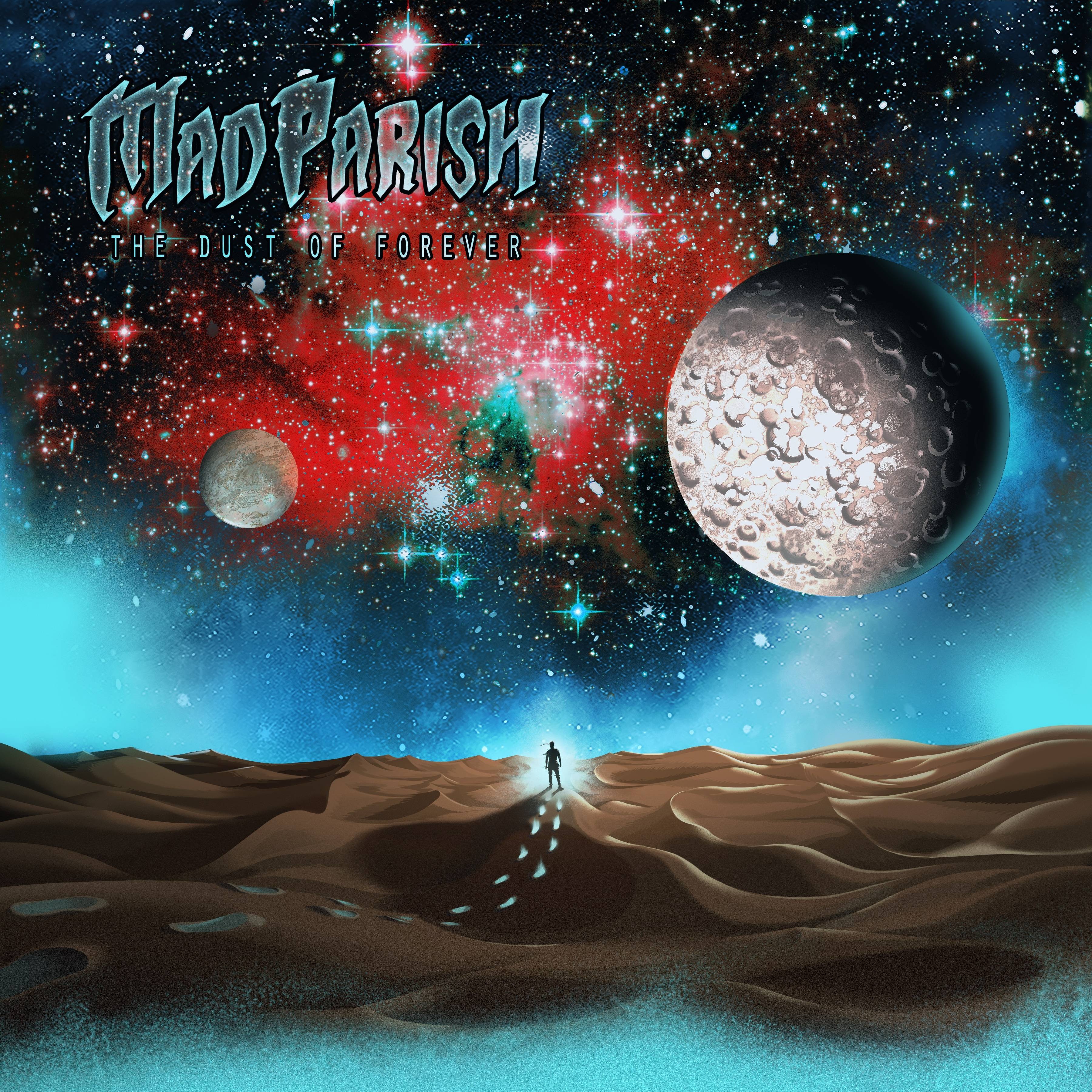
Montreal, Canada’s Mad Parish plays an intriguing blend of NWOBHM, progressive rock, space rock, and 1970’s style hard rock. Formed in 2004, the band presents their second album, an epic concept album titled The Dust of Forever, out now along with a companion comic book!
The Dust of Forever attempts to synthesize Mad Parish’s diverse influences into an epic about space age sound transmission, an “Experience Hunter,” and a priest-turned-immortal. Or at least that’s what I can gather from the lyrics. Truth be told, the narrative arc of The Dust of Forever is difficult to follow without the comic book in hand. In terms of the music presented therein, nearly all of the songs on the album are bookended by interludes, mostly sound transmissions out in the beyond of space. As an album, The Dust of Forever presents a number of interesting musical ideas, some great crunchy riffs, and a few earworm choruses wrapped in a lot of extra materials that do not always serve the album’s interests of compelling a listener with an intriguing and engaging mix of story and sound. The last third of the album (minus one post-lude) shows the most promise for the band and makes me excited to hear what they’ll cook up next.

Review
The Dust of Forever gets off to an odd start with Prophecy, which opens with organs and synths over which a robot voice speaks. Defecther, the first proper track, would have been a stronger start in my opinion, kicking things off with a proggier take on Flight’s sound instead of this puzzling track of garbled robo-speak. From the get-go, the first two tracks encapsulate both the strengths and weaknesses of The Dust of Forever: a largely unnecessary introduction that doesn’t add much to the proceedings, taking some of the shine off of Defecther, which is a strong song. Singer Josh McConnell is front and center here, providing a good dose of drama to the track’s catchy hooks. While I wish the production here and elsewhere was a little punchier to give the songs some heavy metal heft, it is evident from Defecther that Mad Parish can craft a well-made heavy metal song and that they have a strong sense of their own identity as a band.
Possess the Child is up next, and things get a little off the rails here. While there are some truly compelling passages in this tune, it feels overstuffed with ideas, some of which are much stronger than others. In this way, I’d say this song is a good microcosm of the album as a whole: if Mad Parish could rein in and edit down, they could probably craft a very solid 30-40 minute album. And therein lies the problem: The Dust of Forever is a whopping 70 minutes across 21 songs. Frankly, a number of these songs just don’t feel necessary, either to the identity of the album or to the listener’s experience. The album is full of interludes, and few of them feel earned. That being said, Outerest in Irisius, the first of the album’s interludes, is one I enjoy. A light fair of plucked acoustic guitar, flute, and piano, it reminds me of the introduction to “Locomotive Breath” by Jethro Tull. The piano intro to “Locomotive Breath” just makes the big chords hit all the harder when they come in, and Mad Parish attempts to recreate this in the one-two punch of Outerest in Irisius and Ouen Formation. Much like Possess the Child, Ouen Formation is a little on the overstuffed side. If more of the song was spent building to its climactic moments, of which there are a few too many, this one could be a big winner. By this point, I think this album will have weeded out those who aren’t likely to enjoy it, which is too bad because, as we’ll see, the best is yet to come.
Next is Hunted, another brief and fairly uninteresting interlude, followed by Astra T.R.A.Z. (Tower Reformatory Asteroid Zone). If it’s not obvious from the title, this one is another oddball mixture of synthy prog, heavy metal, and space rock. I find this to be one of the more successful songs on the first half of this beast of an album: the choruses get stuck in my head, the various parts fit together well, and the transitions help fit the puzzle pieces into place. McConnell pulls out a falsetto shriek about halfway through the song (a trick he tries elsewhere), and here it is successful: it adds height to the climactic build up of the track.
Up next is, you guessed it, another interlude. While the first interlude was enjoyable but not necessarily integral and the second interlude was a short bit of whatever, here the interludes start to grate a little. Transmission #1 (Dream On) sounds a little like a Beach Boys song intercepted by an alien race in the far reaches of the galaxy. A fun concept, but overall, I just want more heavy metal at this point.
Resistius is here to oblige! Don’t get me wrong, though; this track is still chock full of prog-isms. The integration of these two elements, the heavy metal and the prog rock, works quite effectively in this track. I am reminded particularly of Rush, and of course that’s a good thing. Mixed in is a little of Voivod’s weirdo thrash. When Mad Parish can pull these influences together into a coherent package, it’s a real thrill to hear.
I don’t think I need to tell you what comes next. Aeternal is a short acoustic track with some nice vocal harmonies over top. But I’m not sure what it adds to a heavy prog album except a longer run-time.
An Age to Quell spices things up with some heaviness and some moody Hammond-ish organs. This track sounds like Deep Purple and Rainbow mixed with Rush, and if that sounds awesome Mad Parish nearly pulls it off. Certainly a great track, perhaps the strongest on the album so far, An Age to Quell feels cogent and carefully crafted, something the rest of the album up to this point could use. When I think the best of prog heavy metal, I think of undeniable earworms like “The Eyes of a Stranger,” and this track seems to be shooting for that particular moon. It nearly sticks the landing, and this is one of the tracks that really gets me excited to hear what Mad Parish will come up with on the next album.
…But then, we get another interlude, and this one more frustrating than any that have come before. Transmission #2 (Will of God) is a free jazz tune transported, you guessed it, into outer space. The motif is getting a little tired, and the album is starting to feel long at this point, which is particularly unfortunate because the final third of this album really gets cooking.
Loched, one of the singles released from the album, is a relatively short tune and a pretty effective one. But, at this point in the album, Mad Parish is seemingly out of new tricks (spoiler: they aren’t!).
Cathedron Wakes is one of the longer songs on the album, and for good reason: there are a lot of ideas here, and some great heavy metal riffage. I particularly like the guitar work on this one; after some noodly scales to open up the track, the guitars break into a proggy chug that keeps the energy of the track up. Unfortunately, Mad Parish also pulls out more of the robo-tuned vocals in this song, and they just stick out as gimmicky. Rather than imposing clunky synths and space-faring interludes, I’d rather the album give me the feeling of flying through space through tone and mood. There are real song-writing chops and unquestionable technical virtuosity here and throughout the album, but I want less gimmick and more pure songwriting to shine through.
Book of Rites is one of the less distracting interludes on the album. A one-minute zip of piano arpeggios, it creates a sense of atmosphere and the heft of pathos missing on a lot of the other interludes. It’s also just simply well-played and gives but a brief respite between two of the albums best tracks.
By the time I got to Bishop’s Tomb the first time, I was ready to write off the last third of the album as more of the same. But Bishop’s Tomb absolutely floored me. In short, it kicks ass. It’s the best song on the album. Unquestionably, my bias towards heavier and less noodly metal is showing here, but I can’t help it: this one has an undeniable energy that other tracks could use. If the whole album sounded like this song, I’d still wish it was a little shorter, but I’d be in for the full ride. McConnell’s vocals feel less forced here than some of the other tracks on the album, and the synths add mood and atmosphere, bringing that space-age feel without relying on anything beyond the movements and texture of the song.
Luckily, the last third of the album keeps this momentum going, but not before another interlude. Transmission #3 (Baz Raa Luum) could be forgiven if it were the only interlude on the song, but of it is, by my accounting, the fifth! Mostly the sound of garbled vocal transmissions sent, presumably, into outer space, it is mostly a distraction.
The Experience Hunter reclaims some of the lost momentum and has one of the catchiest choruses on the album with some affecting vocal harmonies layered in to give an otherworldly feel to the singing. This track really makes me think that Mad Parish’s next one, if they learn to cut down on the padding, could make quite a splash. Whereas earlier tracks on the album felt like good ideas mashed together, this track moves smoothly between the different riffs, which provides the epic scope for which the band is aiming with the length of the album.
I don’t have to tell you what to expect next. Trajectory Tantus is two minutes of a quiet drum loop with various echoey sounds and pulsing synths laid over top. Nothing offensive here, but by now the interludes are just exhausting. The template at work here (consciously or unconsciously) is Pink Floyd’s Dark Side of the Moon. What makes the interludes on that album so compelling is that they build and change and play into the larger pacing of the album. Most frustrating is that Mad Parish has shown that they can put together competent and even thrilling songs when they put their minds to it, but the constant interludes show that they need to work on pacing an album with the listener in mind. Most of the interludes are by themselves interesting little pieces of music (or sound), but taken together as a whole the album doesn’t need most of them.
The Dust of Forever leads in with tom-toms before breaking into a chugged introduction. It’s a neat trick, and I wish they’d employ this kind of building into more tracks here. This song has a little of the feel of classic rock at times, which is a nice change of mood. The track carries on a little too long, but is altogether a fitting conclusion to the album. Except that Mad Parish can’t seem to help themselves. The final track, Hail to the Hunter, is about a minute of chanting of the song’s title. Again, nothing offensive here, but the album certainly doesn’t end on a memorable moment.
Conclusion
After several listens, I find myself equally intrigued and frustrated by The Dust of Forever. At it’s best, it offers a thrilling blend of Floydian space rock, the playful prog of Rush, organ-driven Deep Purple, and British heavy metal. But too much of the album is spent trying to cram in space-age synths, vocal effects, and fuzzy echoes to synthesize the feeling of cosmic sound transmission. Even if we were to strip away the many interludes, introductions, and one post-lude, the album would still feel a little overstuffed with ideas, but a stronger musical identity would emerge. I don’t intend these criticisms to be harsh but entirely constructive, as several of the tracks here show that Mad Parish knows what they’re about and they know how to pull off the particular sound they’re going for. The diverse influences create genuine moments of intrigue on the album. It just takes a little too much digging to find those moments.
Links
Bandcamp: https://madparish1.bandcamp.com/
Facebook: https://www.facebook.com/madparishmetal
Instagram: https://www.instagram.com/madparishmetal/
Out 31 January 2025
Line-up:
Josh McConnell – Vocals
Bob Eaglesham – Guitar, Vocals
Aaron Carbray – Guitar
Andre Bisson – Keyboards
Gino Laposta – Bass
Max Rex – Drums